Rat and mouse article
Mouse Droppings: What They Look Like and What They Tell You
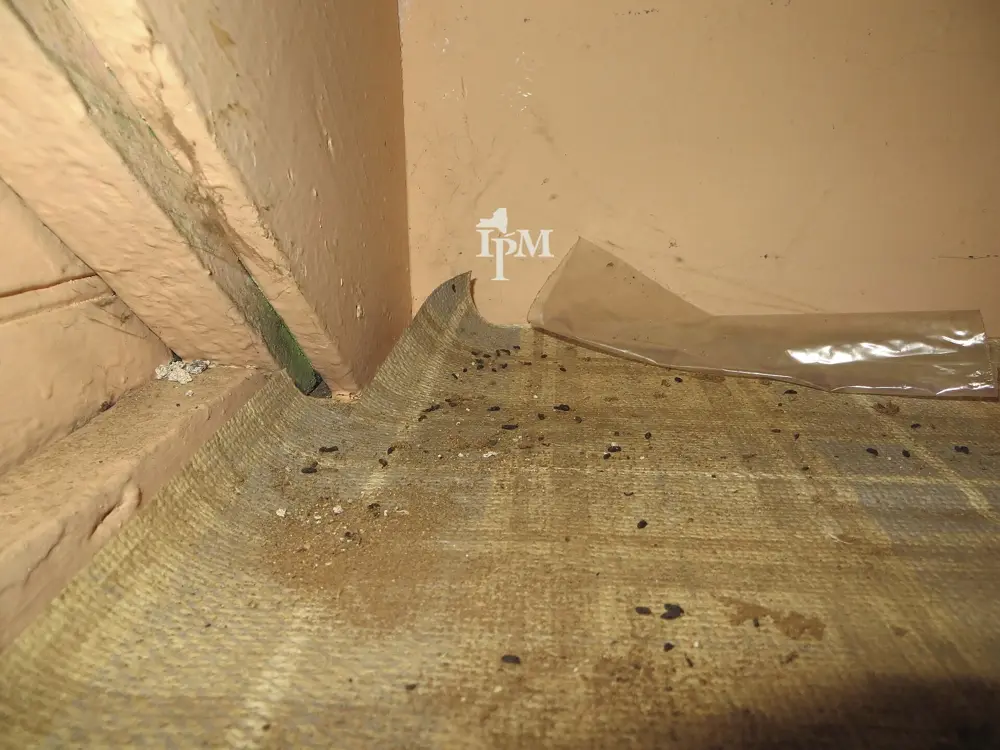
Mouse droppings are small, dark and about the size of a grain of rice, with pointed ends. They're usually scattered along walls, in drawers, on shelves and behind appliances. Fresh ones are dark and a little shiny. Old ones are dull, gray and crumble when pressed with a stick.
Droppings are the best clue you have, because they tell you which animal, roughly how many, how long it's been and where they travel.
Size and shape
House mouse droppings are about the size of a grain of rice and pointed at one or both ends. Woods mice, the white-footed and deer mice common around Akron's parks, leave droppings that look about the same.
Rat droppings are much bigger, closer to a raisin or a bean, with blunt ends. If you're not sure, set one next to a grain of rice. The rat or mouse guide covers the rest of the differences.
Things that get mistaken for mouse droppings
A few look-alikes come up in Akron homes:
- Bat guano, which looks similar but crumbles to a shiny powder and piles up under a roost in the attic or wall
- Cockroach droppings, which are smaller, often look like pepper or smears and have ridges
- Carpenter ant or termite frass, which looks like sawdust or tiny pellets of wood
- Squirrel droppings in the attic, which are larger and more rounded than mouse droppings
Fresh or old?
Fresh droppings are dark, moist-looking and soft. Within a few days they dry and harden. After a few weeks they turn dull and gray and crumble. A useful trick: clean an area thoroughly and check it again in two or three days. New droppings mean active mice. None means the problem may be over, or that they've moved.
Finding both fresh and old droppings in the same spot means mice have been using it for a while. In an Akron basement in January, that usually means they came in during October or November.
Not sure if it's rats or mice? You don't have to know. Describe what you're seeing.
Call (330) 300-0969Droppings in odd places
Some locations surprise people. Droppings in a stove drawer or behind the oven are common, because mice like the warmth and the crumbs. Droppings in a closet with shoes or bags usually mean a gap at the floor along an outside wall. Droppings on top of the furnace or water heater mean mice are following the pipes and flue. Droppings in a car's air filter box mean they're nesting in the engine. Each one points back to a nearby entry or a food source.
What the location tells you
Mice run along walls and leave droppings as they go. A line of them along the top of the basement wall shows the sill line route. Droppings in a kitchen drawer or under the sink mean they're getting into the living space, often along the pipes. Droppings in the attic insulation mean they've climbed the walls. A cluster in one spot near food is a feeding station.
Map where you're finding them. That map tells a technician where to trap and where to look for the gap. If you're finding them around the furnace, the water heater or the laundry, check where the pipes and vents go through the wall.
Not sure if it's rats or mice? You don't have to know. Describe what you're seeing.
Call (330) 300-0969Droppings outside the house
Look outside too. Droppings in the garage, on a shed shelf or in a window well tell you where mice are staging before they come in. Droppings near a hole along the foundation, under a deck or by the garage slab, especially larger blunt ones, point to rats. Finding them outside but not inside is good news: it means the house is still holding, and it's the best time to check the seals.
How many mice is that?
Mice leave a lot of droppings, so a scattering doesn't necessarily mean a big population. What tells you more is how widespread they are. Droppings in one cabinet suggests one or two mice. Droppings in the basement, the kitchen and the attic suggests an established group that's been breeding.
How to clean them up
Follow the CDC's steps. Open doors and windows for 30 minutes and leave the room. Put on rubber or plastic gloves. Spray the droppings until soaked with disinfectant or 1 part bleach to 9 parts water mixed fresh, and let it sit five minutes. Wipe up with paper towels and put them in a covered trash can. Disinfect the area, then wash gloved hands before removing the gloves and wash bare hands after.
Don't sweep or vacuum. The CDC says that can put virus-carrying particles into the air. For a large mess or a crawl space, see droppings cleanup and sanitizing.
Not sure if it's rats or mice? You don't have to know. Describe what you're seeing.
Call (330) 300-0969Common questions
How big are mouse droppings?
About the size of a grain of rice, with pointed ends. Rat droppings are closer to a raisin.
Can I tell how many mice I have from the droppings?
Roughly. How widespread the droppings are tells you more than how many. Several rooms means an established population.
Do mouse droppings smell?
Droppings and urine together give off a musty, stale smell, strongest in closed spaces like cabinets and closets.
Is it safe to touch mouse droppings?
Use gloves and clean them wet with disinfectant. The CDC warns against sweeping or vacuuming them.
Do rats and mice leave droppings in the same places?
Mice scatter droppings along the routes they travel. Rats tend to leave them in clusters near where they feed or hide, often in the basement, garage or near a burrow.